The ghost orchid (Dendrophylax lindenii) is one of the most scientifically fascinating orchids because of its extremely unusual structure and survival strategy. Unlike most plants, it has no visible leaves, and in many cases, no obvious stem above the surface. Instead, nearly all of its biological function is carried out by a highly specialized root system, which makes it a classic example of an epiphytic orchid adapted to life on trees.
The roots of the ghost orchid are flattened, green, and extensively spread across the surface of tree bark, especially in humid swamp forests. These roots are not just for anchoring the plant; they are the primary site of photosynthesis. Because the orchid lacks leaves, chlorophyll in its roots captures sunlight and converts it into energy. This allows the plant to survive in low-light forest environments where traditional leaf-based photosynthesis would be less efficient.
Another key feature of its root system is its ability to absorb moisture and nutrients directly from the air, rainwater, and organic material that accumulates on the bark of host trees. The roots are covered with a spongy outer layer called velamen, which acts like a natural sponge. This layer rapidly absorbs water during rainfall and also helps protect the inner root tissues from drying out during periods of drought.
The ghost orchid does not parasitize the tree it grows on; instead, it uses the tree purely as a physical support. Its roots spread in multiple directions, forming a web-like structure that maximizes exposure to humidity and airflow. This adaptation is especially important in its native swamp habitats, where conditions fluctuate between high humidity and occasional dryness.
Additionally, the ghost orchid has a highly specialized relationship with certain mycorrhizal fungi in the soil and bark ecosystem. These fungi help the orchid obtain essential nutrients, especially during germination and early growth stages, when the plant is most vulnerable and still developing its full root network.
Overall, the ghost orchid’s root system is a remarkable evolutionary adaptation that replaces the functions normally carried out by leaves and soil-based roots. It enables the plant to survive in a very specific ecological niche, making it both highly efficient and extremely sensitive to environmental changes.
Habitat and Growth Conditions
The ghost orchid (Dendrophylax lindenii) is native to highly specific humid tropical and subtropical wetland ecosystems, where environmental conditions remain relatively stable throughout the year. Its natural range is extremely limited, primarily found in the Florida Everglades of the United States, parts of Cuba, and select swamp forests in the Caribbean. These regions share a common set of ecological characteristics that are essential for the orchid’s survival, making it one of the most habitat-sensitive orchid species in the world.
One of the most important requirements for the ghost orchid is consistently high humidity. It thrives in air that is almost constantly saturated with moisture, often found in swamp forests where standing water, seasonal rainfall, and dense vegetation maintain near-continuous humidity. This moisture-rich environment is critical because the orchid relies heavily on its exposed root system to absorb water directly from the air rather than from soil.
Temperature stability is another key factor. The ghost orchid grows best in warm climates with minimal seasonal fluctuation, typically ranging from mild to hot conditions throughout the year. Sudden drops in temperature or prolonged cold periods can severely damage or even kill the plant, as it is not adapted to frost or cold stress.
The species also depends on specific structural conditions in its habitat, particularly the presence of mature, stable host trees. These trees, often found in old-growth swamp forests, provide the physical support needed for the orchid’s epiphytic lifestyle. The bark of these trees is typically rough and moisture-retentive, allowing the orchid’s roots to attach securely and spread across the surface. Importantly, the ghost orchid does not harm its host tree; instead, it uses it purely as a platform to access better airflow and light.
Light conditions in its natural habitat are also highly specialized. The ghost orchid grows under dense forest canopies where direct sunlight is limited. Instead, it prefers filtered or dappled light that passes through layers of vegetation. This low-light environment is ideal for its root-based photosynthesis, as its chlorophyll-containing roots are adapted to capture scattered sunlight efficiently without being exposed to harsh direct rays.
Because it is an epiphyte, the ghost orchid does not grow in soil at any stage of its life cycle. Instead, it anchors itself entirely to tree bark, absorbing water and nutrients from rain, mist, decaying organic matter, and airborne particles. This dependence on atmospheric and host-tree conditions makes it extremely vulnerable to environmental disturbances such as deforestation, drainage of wetlands, and climate change.
Overall, the ghost orchid’s habitat requirements are highly specialized and tightly interdependent, which is why it is considered both ecologically unique and highly endangered.
- Consistently high humidity
- Warm temperatures
- Stable host trees
- Filtered light conditions beneath forest canopies
Rather than growing in soil, it attaches itself to the bark of trees, classifying it as an epiphytic orchid. This growth habit is central to understanding its unique biological adaptations.
Structure of the Ghost Orchid Root System
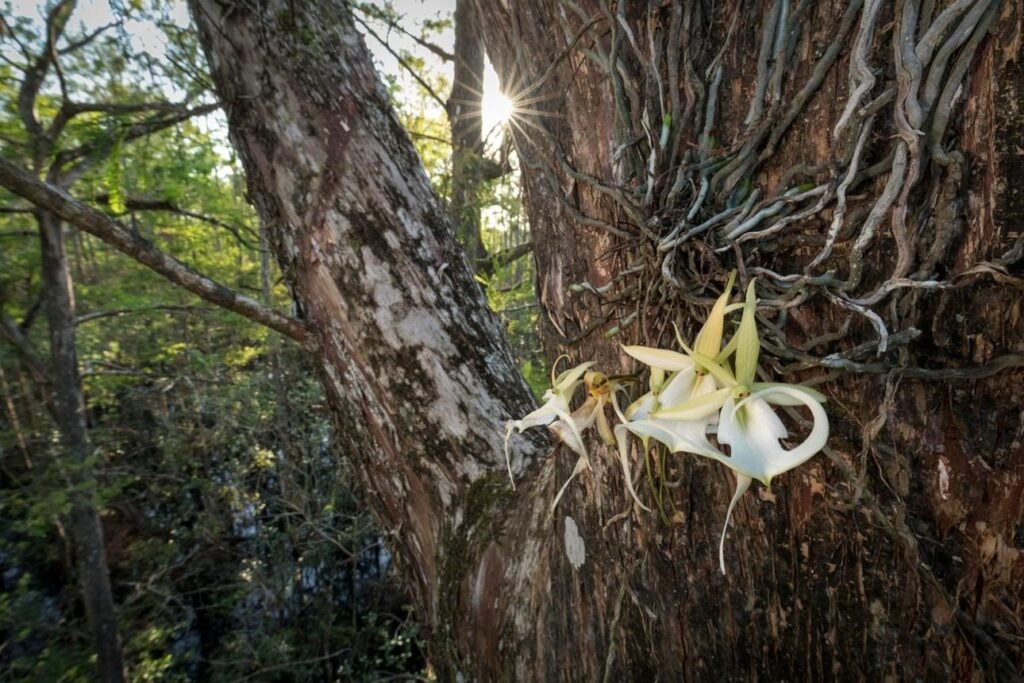
The root system of the ghost orchid (Dendrophylax lindenii) is its most important and fully dominant organ system, replacing many of the functions that are normally performed by leaves and stems in typical plants. In this species, the above-ground leafy structures are almost completely reduced, which means the roots must take on multiple essential roles at the same time, making them highly specialized and physiologically complex.
Instead of forming a traditional underground network, the ghost orchid develops a broad, flattened, and highly branched root structure that spreads across the surface of tree bark. These roots tightly attach to the host tree using specialized adhesive surfaces that allow the plant to remain stable even in humid, windy wetland environments. This anchoring function is crucial because the orchid grows high on trees rather than in soil, where physical stability would otherwise come from buried roots.
Beyond support, these roots are the primary pathway for water absorption. The outer layer of the roots, known as the velamen, acts like a highly efficient sponge that quickly absorbs moisture from rain, fog, and humid air. This adaptation allows the plant to survive in environments where water is not consistently available in liquid soil form. The roots can rapidly take up water during short rainfall events and store it for later use during drier periods.
Nutrient absorption is another essential function of the root system. Since the ghost orchid does not grow in soil, it depends on nutrients dissolved in rainwater as well as organic particles such as decaying leaves, dust, and bark debris that accumulate on tree surfaces. The roots are adapted to capture and process these minimal nutrient sources efficiently, allowing the plant to survive in nutrient-poor environments.
One of the most remarkable features of the ghost orchid’s roots is their ability to perform photosynthesis. Containing chlorophyll, the roots are green and exposed to light, enabling them to convert sunlight into energy. This is highly unusual among flowering plants, as photosynthesis is typically carried out by leaves. In the ghost orchid, the roots effectively replace the role of leaves, making them both structural and metabolic organs.
Because of this combination of functions—anchoring, water absorption, nutrient uptake, and photosynthesis—the ghost orchid root system is considered one of the most advanced examples of epiphytic adaptation in plant biology. It represents a highly efficient evolutionary strategy that allows the plant to survive entirely on tree surfaces in challenging swamp forest ecosystems.
These roots:
- Anchor the plant firmly to tree bark
- Absorb water directly from the atmosphere
- Extract nutrients from rainwater and organic debris
- Carry out photosynthesis
This combination of functions makes the ghost orchid root system one of the most advanced examples of epiphytic adaptation in plant biology.
Aerial Roots and Epiphytic Lifestyle
One of the most defining and unusual characteristics of the ghost orchid (Dendrophylax lindenii) is its complete reliance on aerial roots as part of its epiphytic lifestyle. Unlike terrestrial plants, which develop roots underground to access soil-based water and nutrients, the ghost orchid produces roots that grow entirely above the ground and remain exposed on the surface of tree bark. These roots spread widely across the host tree in a flattened, web-like pattern, forming the plant’s main structural and functional body.
This adaptation is essential for survival in the nutrient-poor environments where the species is found. Since the ghost orchid never makes contact with soil, it cannot rely on traditional root systems for mineral uptake. Instead, it depends on highly efficient aerial absorption mechanisms that allow it to extract resources directly from its surroundings. The plant obtains almost all of its water and nutrients from rainfall, moisture in the humid air, and trace minerals that dissolve on bark surfaces after rain or organic decomposition.
Because these resources are irregular and often available only in small amounts, the orchid’s aerial roots are structurally adapted to maximize efficiency. Their extensive spread across the bark significantly increases surface area, allowing the plant to capture as much moisture as possible whenever humidity levels rise or rainfall occurs. The velamen layer on the roots plays a critical role in this process by rapidly absorbing water and temporarily storing it for later use.
This specialized adaptation is why the ghost orchid is frequently discussed in studies of epiphytic plant biology, particularly in relation to how orchids survive in forest canopy ecosystems without direct access to soil nutrients. Its lifestyle represents a highly efficient evolutionary strategy, enabling it to occupy ecological niches high above the forest floor where competition is lower but resource availability is less predictable.
Overall, the aerial root system not only supports the plant physically but also functions as its primary interface with the environment, allowing it to survive entirely through atmospheric inputs in a highly specialized and delicate ecosystem.
This adaptation is crucial for survival in nutrient-poor environments. Because the plant does not access soil nutrients, it depends entirely on:
- Rainfall
- Humid air
- Dissolved minerals on bark surfaces
This explains why the species is frequently studied in discussions about how epiphytic orchids absorb nutrients from air and adapt to forest canopy ecosystems.
The aerial root system also increases surface area, allowing the plant to maximize water and nutrient absorption in an environment where resources are inconsistent.
Velamen: The Protective and Absorptive Layer
A key and highly specialized structural component of the ghost orchid (Dendrophylax lindenii) root system is the velamen, a thick, spongy, multilayered outer tissue that surrounds the aerial roots. This feature is common in epiphytic orchids, but in the ghost orchid it is particularly well-developed because the plant depends almost entirely on its roots for survival functions such as water uptake, nutrient absorption, and environmental protection.
The velamen plays several interconnected roles that are essential for life in humid but unstable swamp forest ecosystems.
1. Rapid Water Absorption and Storage
One of its most important functions is the rapid absorption of water. During rainfall, heavy dew, or periods of high atmospheric humidity, the velamen quickly soaks up available moisture from the environment. Its layered, sponge-like structure allows it to capture large amounts of water in a short time. This absorbed water is not immediately used but is temporarily stored within the velamen layers and slowly transferred to the inner living tissues of the root. This mechanism ensures that the orchid can maintain hydration even when rainfall is infrequent or humidity levels temporarily drop, which is common in its natural habitat.
2. Nutrient Capture from the Environment
In addition to water, the velamen also functions as a natural filtering system for nutrients. As rainwater flows over tree bark and surrounding surfaces, it carries dissolved minerals, decomposed organic matter, dust particles, and microorganisms. The velamen traps these fine particles within its porous structure, effectively concentrating scarce nutrients from the environment. Over time, these materials are broken down and absorbed into the inner root system, providing the orchid with essential elements such as nitrogen, potassium, and other minerals that would normally be obtained from soil.
3. Protection Against Desiccation and Environmental Stress
Because ghost orchid roots are exposed directly to air, they are highly vulnerable to drying out. The velamen acts as a protective outer barrier that significantly reduces water loss from the internal tissues. Its layered structure slows evaporation and helps maintain internal moisture levels for longer periods. In addition to preventing desiccation, it also provides physical protection against environmental stress such as sudden temperature changes, intense sunlight exposure, and mechanical damage from wind or debris in swamp forest canopies.
Overall, the velamen is far more than a simple outer covering—it is a multifunctional adaptation that integrates water management, nutrient acquisition, and protective insulation into a single structure. This makes it central to understanding how the ghost orchid survives in its fluctuating swamp habitat, where resources are irregular and environmental conditions can change rapidly.
Photosynthesis Through Roots
One of the most remarkable and scientifically significant characteristics of the ghost orchid (Dendrophylax lindenii) is its ability to carry out photosynthesis directly through its roots. This is highly unusual in the plant kingdom, as photosynthesis is almost always performed by leaves. In the ghost orchid, however, the leaves are extremely reduced or completely absent, meaning the plant has evolved a unique system in which its roots take over this essential function.
Instead of relying on broad leaf surfaces to capture sunlight, the ghost orchid’s aerial roots spread across tree bark in exposed patterns that maximize light absorption. The outer tissues of these roots contain chlorophyll, the green pigment responsible for capturing sunlight. This allows the roots to function similarly to leaves by absorbing light energy directly from the forest canopy environment.
Once sunlight is captured, the chlorophyll within the root tissues converts this light energy into chemical energy through the process of photosynthesis. This energy is then used to support the plant’s basic metabolic activities, including growth, maintenance, and reproduction. Because the roots are spread across multiple surfaces and exposed to diffused light filtering through the forest canopy, they are well adapted to low-light but stable humidity conditions typical of swamp forests.
This root-based photosynthetic system is particularly important because it compensates for the absence of traditional foliage. Without leaves, most plants would be unable to produce enough energy to survive, but the ghost orchid has evolved a highly efficient alternative strategy that integrates both structural and metabolic functions into its root system.
This adaptation is a key reason why the species is widely studied in botanical research. It represents a rare evolutionary shift where a plant has relocated its primary photosynthetic activity from leaves to roots. This not only challenges conventional understanding of plant physiology but also highlights the extreme specialization of epiphytic orchids in adapting to canopy-based ecosystems.
Unlike most plants, the ghost orchid has very small or non-functional leaves. As a result, the roots take over the role typically performed by foliage.
The outer layer of the roots contains chlorophyll, allowing them to:
- Capture sunlight
- Convert light energy into chemical energy
- Support the plant’s metabolic needs
This adaptation is a major reason why researchers study how ghost orchids perform photosynthesis through roots rather than leaves. It represents a rare evolutionary shift in plant function.
How the Ghost Orchid Survives Without Leaves
A major question in botanical research is how the ghost orchid (Dendrophylax lindenii) is able to survive without leaves, since leaves are typically essential for photosynthesis and gas exchange in most plants. The answer lies in a highly specialized set of evolutionary adaptations that allow the plant to completely reorganize how it produces energy, conserves water, and obtains nutrients.
Instead of leaves, the ghost orchid relies on photosynthetic roots, which take over the primary role of energy production. These roots contain chlorophyll and are spread across tree bark in wide, exposed networks that allow them to capture diffused sunlight filtering through the forest canopy. In this way, the roots function as both structural anchors and photosynthetic organs, effectively replacing the role that leaves normally play.
The plant also depends heavily on atmospheric moisture and humidity for survival. Since it grows in swamp forests with consistently humid air, its aerial roots are able to absorb water directly from rain, fog, and moisture in the environment. This reduces the need for large leaf surfaces, which in most plants are used not only for photosynthesis but also for regulating water exchange.
Another key factor is its very slow growth rate and low energy demand. The ghost orchid does not grow rapidly or produce large structures, which significantly reduces its overall metabolic requirements. Because it has a minimal biomass and no energy-demanding leaves or stems, it can survive on relatively small and intermittent inputs of nutrients and light.
In addition, the orchid has developed efficient nutrient recycling and uptake mechanisms. It absorbs dissolved minerals and organic particles from rainwater and decomposing matter on tree bark, making use of very limited resources in its environment. This efficient nutrient use allows it to sustain itself even in nutrient-poor canopy ecosystems.
The absence of leaves also provides an important advantage: it reduces water loss. In most plants, leaves are a major site of transpiration, where water is lost to the atmosphere. By eliminating leaves entirely, the ghost orchid minimizes dehydration risk, which is especially beneficial in exposed canopy habitats where humidity and moisture levels can fluctuate.
Overall, the ghost orchid survives without leaves through a combination of structural reduction, metabolic efficiency, and extreme specialization. It is one of the most advanced examples of adaptation among orchids, demonstrating how a plant can completely shift traditional biological functions into a single highly optimized organ system.
Environmental Adaptations in Swamp Ecosystems
The ghost orchid (Dendrophylax lindenii) is highly specialized to survive within the very specific microclimate of tropical and subtropical swamp forests, particularly those found in southern Florida’s Everglades region. These ecosystems are characterized by a delicate balance of temperature, humidity, and ecological stability, all of which are essential for the orchid’s survival.
One of the most critical requirements is persistent high humidity. The air in swamp forests is often saturated with moisture due to standing water, frequent rainfall, and dense vegetation cover. This constant humidity allows the ghost orchid’s aerial roots to remain hydrated and function effectively in absorbing water directly from the atmosphere. Without this moisture-rich environment, the plant’s root-based survival system would quickly fail.
Another key factor is stable temperature ranges throughout the year. The ghost orchid is adapted to warm tropical conditions with very limited seasonal variation. Sudden temperature drops or prolonged cold periods can disrupt its metabolic processes and damage its sensitive root tissues. As a result, it thrives only in regions where temperatures remain relatively consistent and frost is absent.
The species also depends on clean, unpolluted air, since its aerial roots directly interact with atmospheric moisture and airborne particles. Pollutants, dust imbalance, or chemical contaminants can interfere with nutrient absorption and damage the delicate velamen layer of the roots. This makes the ghost orchid particularly sensitive to environmental degradation caused by human activity.
Equally important is the presence of mature host trees, which provide the physical structure needed for anchorage. These trees, often found in old-growth swamp forests, have rough bark that allows the orchid’s roots to attach securely and spread across the surface. The stability of these trees ensures that the orchid remains in a fixed position where humidity, airflow, and light conditions remain optimal over long periods.
Together, these conditions define the survival mechanism of the ghost orchid in the Florida Everglades. However, this extreme specialization also makes the species highly vulnerable. Any disruption—such as deforestation, drainage of wetlands, pollution, or climate change—can significantly impact its ability to survive, since it cannot easily adapt to different environmental conditions.
Comparison with Other Orchids
When compared to typical orchid species, the ghost orchid stands out as one of the most highly specialized and evolutionarily reduced members of the orchid family. Most orchids maintain a more balanced plant structure, with clearly developed leaves, stems, and roots, each serving distinct biological functions.
In most orchid species, leaves play the primary role in photosynthesis, capturing sunlight and producing the energy needed for growth. Their roots, on the other hand, are mainly responsible for anchorage and water or nutrient absorption from soil or growing media. This separation of functions allows many orchids to adapt to a wide range of habitats, from tropical forests to temperate environments.
Typical orchids are also generally more ecologically flexible, meaning they can tolerate variations in temperature, humidity, and light conditions. This adaptability allows them to survive in different regions and even under cultivation with relative ease.
In contrast, the ghost orchid represents a highly specialized deviation from this general pattern. It relies almost entirely on its root system for multiple critical functions, including photosynthesis, water absorption, nutrient uptake, and structural support. Its leaves are extremely reduced or entirely absent, which is highly unusual among flowering plants.
Additionally, it requires very specific environmental conditions, including constant humidity, stable temperatures, and intact swamp forest ecosystems. This narrow ecological niche makes it far less adaptable than most other orchids and explains why it is considered both rare and endangered.
Overall, the ghost orchid illustrates a striking evolutionary pathway within the orchid family, where conventional plant structures are minimized and replaced by an advanced, multifunctional root system. This highlights the clear difference between the ghost orchid and other orchid root systems, emphasizing its status as one of the most specialized epiphytic plants known in botany.
Ecological Importance and Rarity
The ghost orchid (Dendrophylax lindenii) is not only remarkable for its unusual biological structure, but also for its important ecological role within swamp forest ecosystems. Although it exists in small numbers and in highly specific locations, it contributes to the overall balance and functioning of its habitat in several subtle but meaningful ways.
One important role is its contribution to micro-ecosystems on tree bark surfaces. As an epiphytic plant, the ghost orchid lives attached to the bark of trees rather than in soil. Its extensive root system creates small microhabitats where moisture, organic debris, fungi, and microorganisms accumulate. These microenvironments support tiny ecological communities, including bacteria, fungi, and small invertebrates, helping to maintain biodiversity at a microscopic scale within swamp forests.
The ghost orchid also plays a specialized role in pollinator interactions, particularly with certain nocturnal moth species. Its flower structure and scent are adapted to attract long-tongued moths, which are capable of reaching deep into the flower to access nectar. This relationship is highly specialized, meaning that the orchid depends on a limited number of pollinators, and those pollinators may also rely on the orchid as a nectar source. This tight ecological connection makes the species an important part of local pollination networks.
In addition, the ghost orchid serves as an indicator species for ecosystem health. Because it requires very specific conditions—such as stable humidity, clean air, intact swamp forests, and mature host trees—its presence often signals that the surrounding environment is relatively undisturbed and ecologically balanced. Conversely, a decline in ghost orchid populations can indicate habitat degradation or changes in environmental quality.
The rarity of the ghost orchid is primarily due to its extremely narrow habitat requirements and high sensitivity to environmental change. It cannot easily adapt to altered conditions, which means even small disruptions in humidity, water levels, or forest structure can significantly affect its survival.
Conservation Concerns
Due to its specialized biology and limited distribution, the ghost orchid is highly vulnerable to a range of environmental and human-induced threats. One of the most serious threats is habitat destruction, particularly the drainage of wetlands, deforestation, and land conversion in regions like the Florida Everglades. These changes directly reduce the availability of suitable host trees and disrupt the delicate microclimate required for the orchid’s survival.
Another major concern is illegal collection and poaching. Because of its rarity and unique appearance, the ghost orchid has historically been targeted by plant collectors. Removing even a small number of individuals from the wild can have a significant impact on already fragile populations, especially given its slow growth and low reproductive rate.
Climate change also poses a long-term threat. Shifts in rainfall patterns, rising temperatures, and changes in humidity levels can disrupt the stable swamp conditions that the species depends on. Even slight variations in moisture availability can affect root function and reduce the plant’s ability to survive.
In addition, changes in water levels and hydrology—such as those caused by human water management systems or prolonged droughts—can alter the swamp ecosystem structure. Since the ghost orchid depends on consistently humid conditions, any reduction in environmental moisture can severely impact its populations.
Conservation efforts for the ghost orchid therefore focus primarily on protecting and restoring wetland ecosystems, particularly in the Florida Everglades and similar habitats. This includes preserving mature host trees, maintaining natural water flow patterns, preventing habitat fragmentation, and enforcing protections against illegal collection. By safeguarding the broader ecosystem rather than just the plant itself, conservationists aim to ensure that the delicate environmental conditions required for the ghost orchid continue to exist.
Conclusion
The ghost orchid (Dendrophylax lindenii) represents one of the most extreme and highly specialized examples of plant adaptation within the orchid family. Unlike most flowering plants, which divide essential functions among leaves, stems, and roots, this species has undergone a dramatic evolutionary reduction in which nearly all above-ground structures are minimized or absent. As a result, its root system has become the central and multifunctional organ responsible for nearly every aspect of survival.
In this highly specialized system, the roots do far more than simply anchor the plant to tree bark. They function simultaneously as a structural support system, securing the orchid firmly to its host tree in unstable swamp environments; a nutrient absorption interface, capturing water, minerals, and organic particles directly from rain, humidity, and decomposing material; and a photosynthetic surface, containing chlorophyll that allows the roots to convert sunlight into chemical energy. This rare combination of roles in a single organ system is highly unusual in vascular plants and represents a significant deviation from typical plant structure.
These adaptations allow the ghost orchid to survive in humid swamp forests where traditional plant designs would be ineffective. In such environments, soil-based resources are limited or inaccessible, and environmental conditions fluctuate between periods of intense moisture and relative dryness. By relying on aerial roots and atmospheric inputs rather than soil, the ghost orchid is able to occupy a unique ecological niche high within forest canopies.
For researchers, Dendrophylax lindenii remains a species of exceptional scientific importance. It provides valuable insight into the evolution of epiphytic orchids, the plasticity of plant organ function, and the ways in which plants can radically reorganize their biology to adapt to extreme or specialized environments. Its study also contributes to a deeper understanding of root-based photosynthesis, nutrient absorption from atmospheric sources, and the ecological dynamics of swamp forest ecosystems.
Overall, the ghost orchid stands as a striking example of evolutionary innovation, demonstrating how extreme environmental pressures can reshape a plant’s structure and function into a highly efficient but fragile survival strategy.