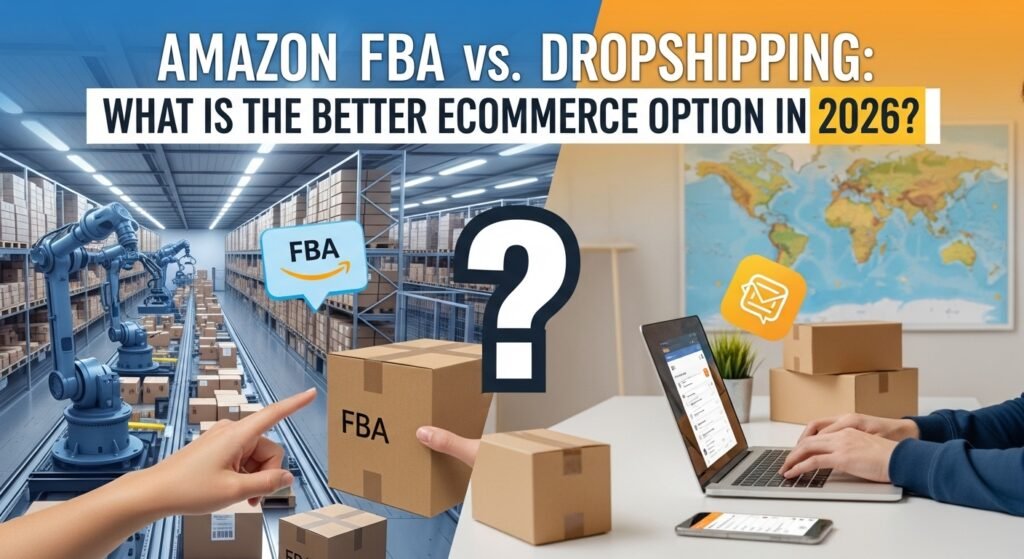
Starting an ecommerce business has, over the last few years, become one of the most accessible ways of earning money online. However, as the digital landscape continues to evolve, more and more aspiring entrepreneurs are asking themselves the question: “Amazon FBA vs. dropshipping: which option is better?”
Both of these models have unique benefits, allowing entrepreneurs to start a business without the need to open a brick-and-mortar store. However, the two models have a number of differences, which must be understood if you are looking to start a business.
In the following article, we have tried to provide a comprehensive comparison of the two models, helping you understand which option suits you best.
Understanding the Amazon FBA Model
Amazon FBA, or ‘Amazon Fulfillment by Amazon,’ refers to a business model wherein entrepreneurs take advantage of the infrastructure of the online retail giant. In the case of the FBA model, the entrepreneur or the seller sends the products directly to the warehouse of the company, which then handles the logistics of the sale.
This allows entrepreneurs more freedom to concentrate on other aspects of the business, such as product research. Thus, the FBA model has gained immense popularity as a way of building a business. The first reason behind the popularity of the FBA model lies in the trust associated with the brand. Products associated with the brand have a higher likelihood of being sold as the brand has a history of providing timely delivery.
Understanding Dropshipping
On the other hand, dropshipping is a business model that does not require the entrepreneur to deal with inventory management. In other words, the entrepreneur does not have to buy the products prior to the sale. Instead, the entrepreneur simply adds the products to the store, and when a customer buys the product, the supplier ships the product directly to the customer.
This business model has made dropshipping a favorite among beginners. The entrepreneur does not have to spend a fortune at the beginning of the business. In fact, the entrepreneur can easily set up the store, test the products, and then move on based on the demands of the market. The flexibility of the dropshipping business model has made it the perfect option for beginners.
Despite the convenience of the dropshipping business model, there are certain disadvantages. In the case of dropshipping, the entrepreneur does not have control over the inventory. In other words, the entrepreneur has to rely on the supplier.
Key Differences Between Amazon FBA and Dropshipping
In order to understand the differences between the two business models, there are certain factors that have to be taken into account. These factors include the cost, the profitability of the business, the ease of entry, and the potential of the business.
The first difference between the two business models lies in the cost. In the case of the Amazon FBA, the entrepreneur has to spend more at the beginning of the business. In other words, the entrepreneur has to buy the inventory, as well as the shipping costs. On the other hand, the entrepreneur can easily start the dropshipping business with a small amount of capital, as the products are bought after the sale.
The second difference lies in the profitability of the business. In the case of the Amazon FBA, the entrepreneur can easily make more profits, as the entrepreneur buys the inventory in bulk. In the case of the dropshipping business, the entrepreneur does not make as much profit, as the supplier charges more.
On ease of starting, dropshipping takes the lead. It is easier for a beginner to venture into business. Although Amazon FBA is more challenging to start, it can become easier to manage in the long run due to the automated process.
On the other hand, when considering risks, Amazon FBA comes with financial risks due to unsold items. On the other hand, dropshipping comes with operational risks.
Shipping and Customer Experience

Customer experience is a vital aspect in ensuring a business is successful. In dropshipping and Amazon FBA, customer experience is excellent. Amazon FBA provides fast and reliable shipping. The customer receives their package in just a day or two. This greatly contributes to customer satisfaction.
On the other hand, dropshipping may take a long period to deliver. In most cases, dropshippers may source their items from international suppliers. This may cause a negative impact on customer satisfaction. Although there are dropshippers who offer fast shipping, consistency may be a challenge.
Scalability and Growth Potential
Scalability is another vital aspect to consider when choosing between dropshipping and Amazon FBA. In Amazon FBA, scalability is easier. Once a product is successful, Amazon FBA can be scaled. The automated process makes it easier to venture into other ventures.
On the other hand, dropshipping can be scaled. However, dropshipping may require a lot of effort to maintain advertisements.
Control and Branding Opportunities
For entrepreneurs who are interested in building a brand, Amazon FBA offers many opportunities. However, for those who are interested in dropshipping, this platform does not offer many opportunities in this regard. Since most products are dropshipped from other companies, it is more difficult to differentiate your company from another company in this field. As such, it would be more difficult to build a unique brand for your company.
Suitability for Beginners
Another way to differentiate between Amazon FBA and dropshipping is to consider whether you are a beginner in this field and whether you are financially stable. For beginners who are financially unstable, dropshipping would be more suitable for them. This is because this platform would help them gain experience in this field and understand market trends.
For those who are financially stable and willing to invest in this field, Amazon FBA would be more beneficial for them. Although this platform requires more work, it would be more beneficial in the long run. The Perspective in 2026 As we move forward into 2026 and the world of ecommerce continues to grow, we are seeing certain trends emerge in this field. As such, we are seeing more and more people wanting to get their products to them quicker, wanting better quality products, and wanting a more personalized experience. As such, this would be more beneficial for Amazon FBA because this platform would be able to offer this to them. However, this platform would also be good for those who are looking for new products and are willing to test them out. As such, this would be more beneficial for dropshipping. Final Thoughts
In conclusion, the debate about “Amazon FBA vs. dropshipping – which one is better?” does not have a definitive answer. Instead, each model is unique and suitable for different kinds of entrepreneurs.
For instance, dropshipping is best suited for entrepreneurs who want to test the waters with little risk and explore the world of ecommerce. On the other hand, Amazon FBA is best suited for entrepreneurs who want to establish a long-term business with high margins and opportunities for brand building.
The best strategy for entrepreneurs is to start with dropshipping and then move to Amazon FBA. This will allow entrepreneurs to benefit from the advantages of both business models without taking unnecessary risks.
It is worth noting that success in the world of ecommerce does not only depend on the business model adopted, but also on the entrepreneur’s willingness to be consistent, conduct thorough market research, and be willing to adapt to new trends.